07 November 2026
Table of Contents
Kidney cancer treatment has changed a great deal in recent years. One of the biggest shifts has been the rise of immunotherapy, treatment that helps your own immune system recognise and attack cancer cells.
Today, immunotherapy is used at more than one stage of kidney cancer: after surgery for some people at higher risk of the cancer coming back, and as a main treatment for many people with advanced disease. This guide explains, in simple language, how immunotherapy works in kidney cancer, who it may help, how it is given, what side effects to watch for and what results to expect.
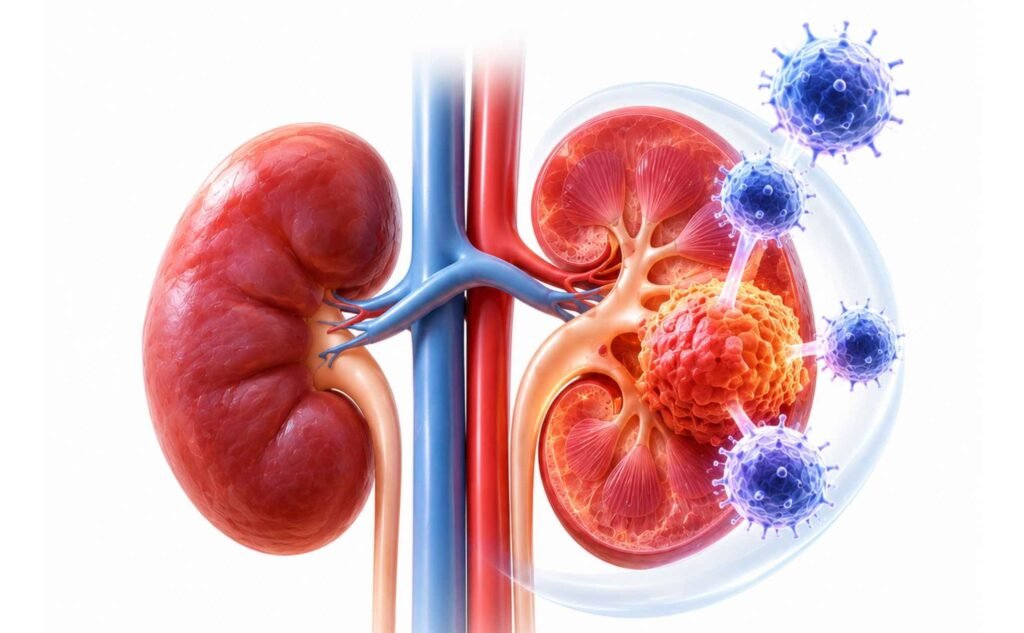
Kidney Cancer in Simple Words
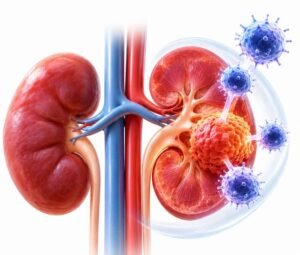
The kidneys are two bean-shaped organs that filter waste from the blood and make urine. Most kidney cancers in adults are renal cell carcinoma (RCC), which starts in the lining of the tiny tubes inside the kidney.
There are several types of RCC. The most common is clear cell RCC, named after how the cells look under a microscope. Other types, grouped together as non-clear cell RCC, include papillary and chromophobe RCC. The type matters, because it affects which treatments work best.
Kidney cancer is often found by chance on a scan done for another reason. When it causes symptoms, these may include blood in the urine, pain in the side or back, a lump in the tummy, tiredness or weight loss.
What Is Immunotherapy?
Your immune system has cells called T cells that can find and destroy harmful cells. To stop T cells from attacking healthy tissue, the body uses natural “brakes” called immune checkpoints.
Cancer cells can misuse these brakes to switch T cells off and hide. The main type of immunotherapy used in kidney cancer, immune checkpoint inhibitors, blocks these brakes. This allows the T cells to recognise and attack the cancer.
There are different checkpoint inhibitors that work on different brakes, known by short names such as PD-1, PD-L1 and CTLA-4. Your oncologist will explain which one, or which combination, is suitable for you.
Why Does Immunotherapy Work in Kidney Cancer?
Kidney cancer has long been known as one of the cancers that can respond to the immune system. Doctors have observed that the immune system can sometimes slow or even shrink kidney cancers on its own.
Kidney cancer also does not respond well to traditional chemotherapy. This made it an important focus for newer treatments. Over the past several years, large studies have shown that checkpoint inhibitors, alone or in combination, can help many people with kidney cancer live longer and keep the cancer under control.
Immunotherapy After Surgery
Surgery to remove the cancer, either part of the kidney or the whole kidney, is the main treatment for kidney cancer that has not spread. For many people, surgery alone is enough.
However, some people have features that mean the cancer is more likely to come back, such as a larger tumour, spread into nearby tissue or lymph nodes, or certain features seen under the microscope. For some of these people with clear cell RCC, doctors may recommend immunotherapy after surgery. This is called adjuvant immunotherapy.
- It aims to destroy any cancer cells that may remain after surgery and are too small to see on scans.
- It is usually given for up to about a year.
- Studies have shown that it lowers the chance of the cancer coming back and helps people live longer.
Is adjuvant immunotherapy right for everyone?
No. It is offered to selected people with a higher risk of recurrence, because immunotherapy can cause side effects. Your oncologist will look at your surgery and pathology report and discuss whether the benefits outweigh the risks for you.
Immunotherapy for Advanced Kidney Cancer
When kidney cancer has spread to other parts of the body, such as the lungs, bones or lymph nodes, or cannot be removed with surgery, it is called advanced or metastatic kidney cancer. For many people with advanced clear cell RCC, immunotherapy-based treatment is now a common first treatment.
Doctors usually use one of two types of combination:
- Two immunotherapies together: two checkpoint inhibitors that release different brakes, given together for a few doses and then one is continued.
- Immunotherapy plus targeted therapy: a checkpoint inhibitor combined with a targeted tablet that blocks the blood supply the tumour needs to grow.
Which combination is chosen depends on your risk group, which doctors work out from things like how long it has been since diagnosis, your blood test results and how well you are managing day to day. It also depends on your other health conditions, how quickly the cancer is growing and your preferences.
For non-clear cell RCC, there is less research, but immunotherapy-based combinations may still be used in some cases. Clinical trials may also be an option.
If the cancer grows despite first treatment, other options, including different targeted therapies, may be used. Sometimes immunotherapy is used in a later line if it was not given first.
Comparing the Main Approaches
| Feature | Immunotherapy alone | Two immunotherapies | Immunotherapy plus targeted therapy |
|---|---|---|---|
| Main use | After surgery for higher-risk clear cell RCC; sometimes later lines | First treatment for some advanced kidney cancers | First treatment for many advanced kidney cancers |
| How given | Drip every few weeks | Drips, two medicines at first, then one | Drip every few weeks plus a daily tablet |
| How it works | Releases one immune brake | Releases two different immune brakes | Releases an immune brake and cuts the tumour's blood supply |
| Typical side effects | Tiredness, skin rash, thyroid changes | Immune side effects can be more frequent | Immune side effects plus high blood pressure, diarrhoea, mouth and hand-foot soreness |
Who May Benefit Most?
Immunotherapy may be considered for:
- People with clear cell RCC at higher risk of recurrence after surgery
- People with advanced or metastatic clear cell RCC, often as a first treatment
- Some people with non-clear cell RCC, after specialist review
- People whose cancer has grown on other treatments, if they have not had immunotherapy before
Immunotherapy may need extra caution in people with active autoimmune diseases (such as severe rheumatoid arthritis, lupus or inflammatory bowel disease), people who have had an organ transplant, and people taking high doses of steroids. These conditions do not always rule it out, but they need careful discussion.
How Is Immunotherapy Given?
Checkpoint inhibitors are given as a drip into a vein in a day-care unit. Each infusion usually takes a short time, and you can go home the same day. Depending on the medicine, treatment is repeated every few weeks.
Before each dose, you will usually have blood tests to check your blood counts, liver, kidneys, thyroid and other hormones. Scans are done every few months to see how the cancer is responding. If you are also on a targeted tablet, you will take it at home and your blood pressure will be checked regularly.
Side Effects to Know About
Because immunotherapy boosts the immune system, it can sometimes cause the immune system to affect healthy organs. These are called immune-related side effects. Most are mild to moderate and can be managed well if reported early.
- Tiredness
- Skin: rash, itching
- Gut: diarrhoea, stomach pain (colitis)
- Hormone glands: an underactive or overactive thyroid, or effects on other glands, causing tiredness, weight change or feeling cold or hot
- Liver: inflammation, usually found on blood tests
- Lungs: cough or breathlessness (pneumonitis), which is less common but important
- Kidneys: inflammation, which is especially important to watch for in people who already have one kidney or reduced kidney function
Side effects can appear at any time, including weeks or months after treatment has stopped. Most are treated with steroids or other medicines, and treatment may be paused. Some hormone side effects need lifelong hormone tablets, which are easy to take.
Contact your oncology team straight away if you have
- Diarrhoea, blood in stools or severe stomach pain
- A new cough or breathlessness
- Yellow skin or eyes, or very dark urine
- Severe tiredness, headache, dizziness or vision changes
- Passing much less urine, or swelling of the legs
- Fever or signs of infection
What Results Can Patients Expect?
Responses to immunotherapy vary from person to person:
- Some people see the cancer shrink, and in some, it disappears on scans.
- Some people have stable disease, meaning the cancer stops growing, which is also a good outcome.
- Some people do not respond, and other treatments are then considered.
A special feature of immunotherapy is that, for some people, the benefit can last a long time, even after treatment is stopped. Responses can also take a while to appear. Occasionally, tumours may look larger on early scans because immune cells are gathering in them, before shrinking later. Your oncologist will interpret scans carefully with this in mind.
Key takeaways
- Immunotherapy helps the immune system find and attack kidney cancer by releasing natural brakes on T cells.
- After surgery, it may be offered to selected people with higher-risk clear cell RCC to lower the chance of the cancer returning.
- For advanced kidney cancer, immunotherapy-based combinations are now a common first treatment.
- Side effects are usually manageable but must be reported early.
- Benefits can be long-lasting for some people.
Frequently Asked Questions
No. It is mainly used for clear cell renal cell carcinoma, either after surgery in higher-risk cases or for advanced disease. For non-clear cell types, it may be used in some situations after specialist review. Many early kidney cancers are treated with surgery alone.
No. Chemotherapy directly kills fast-growing cells. Immunotherapy works by helping your own immune system attack the cancer. Kidney cancer generally does not respond well to traditional chemotherapy, which is one reason immunotherapy has become so important.
Not necessarily. Adjuvant immunotherapy is offered only to some people with clear cell RCC who have a higher risk of the cancer coming back. Your oncologist will review your surgery and pathology report to decide whether it is recommended for you.
After surgery, adjuvant immunotherapy is usually given for up to about a year. For advanced cancer, treatment often continues for as long as it is working and side effects are manageable, sometimes for up to a couple of years, after which your doctor may discuss stopping.
Often, yes. Many people receive immunotherapy after having a kidney removed. Your team will monitor kidney function closely, because immunotherapy can occasionally cause kidney inflammation.
Combining two immunotherapies, or immunotherapy with a targeted tablet, attacks the cancer in two different ways. For many people with advanced kidney cancer, combinations work better than a single medicine, though side effects need careful monitoring.
Your team will usually check with scans every few months. Some people also notice that symptoms improve. Because immunotherapy can take time to work, your oncologist may not change treatment based on one early scan alone.
Yes. Immune-related side effects can appear weeks or even months after the last dose. Always tell any doctor you see that you have had immunotherapy, and report new symptoms to your oncology team.
Many people continue working, especially as treatment is usually given as a day-care visit every few weeks. Tiredness and side effects vary, so it helps to plan flexibly and discuss your work with your team.
Yes. Checkpoint inhibitor immunotherapy and targeted therapies for kidney cancer are available in India. Your oncologist will advise which option suits your cancer type, stage and overall health.
A Final Word
Immunotherapy has opened new possibilities for people with kidney cancer, from lowering the chance of the cancer coming back after surgery to offering long-lasting control for many with advanced disease. Understanding how it works can help you take an active part in your treatment decisions.
If you or a loved one has been diagnosed with kidney cancer, a consultation with a medical oncology specialist can help you understand whether immunotherapy is suitable and how it fits into your overall treatment plan.