09 April 2026
Table of Contents
When standard treatment hasn’t worked the way everyone hoped — or when leukaemia comes back — the question every family asks is: what now? If you’ve been hearing about CAR-T cell therapy, you’re not alone, and you’ve come to the right place to understand what it actually means.
Let’s start with something important: this is not a last resort. CAR-T cell therapy is a genuinely advanced, science-backed treatment that has changed outcomes for many leukaemia patients, including children. It’s not experimental in the way people sometimes fear. It’s approved, available, and being delivered right here in Mumbai.
So let’s walk through what it is, how it works, and what the journey looks like for families in India who are exploring this option.
What Is CAR-T Cell Therapy for Leukaemia?
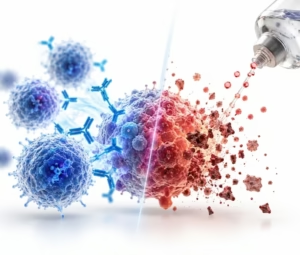
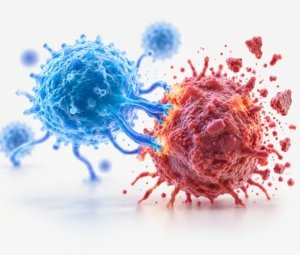
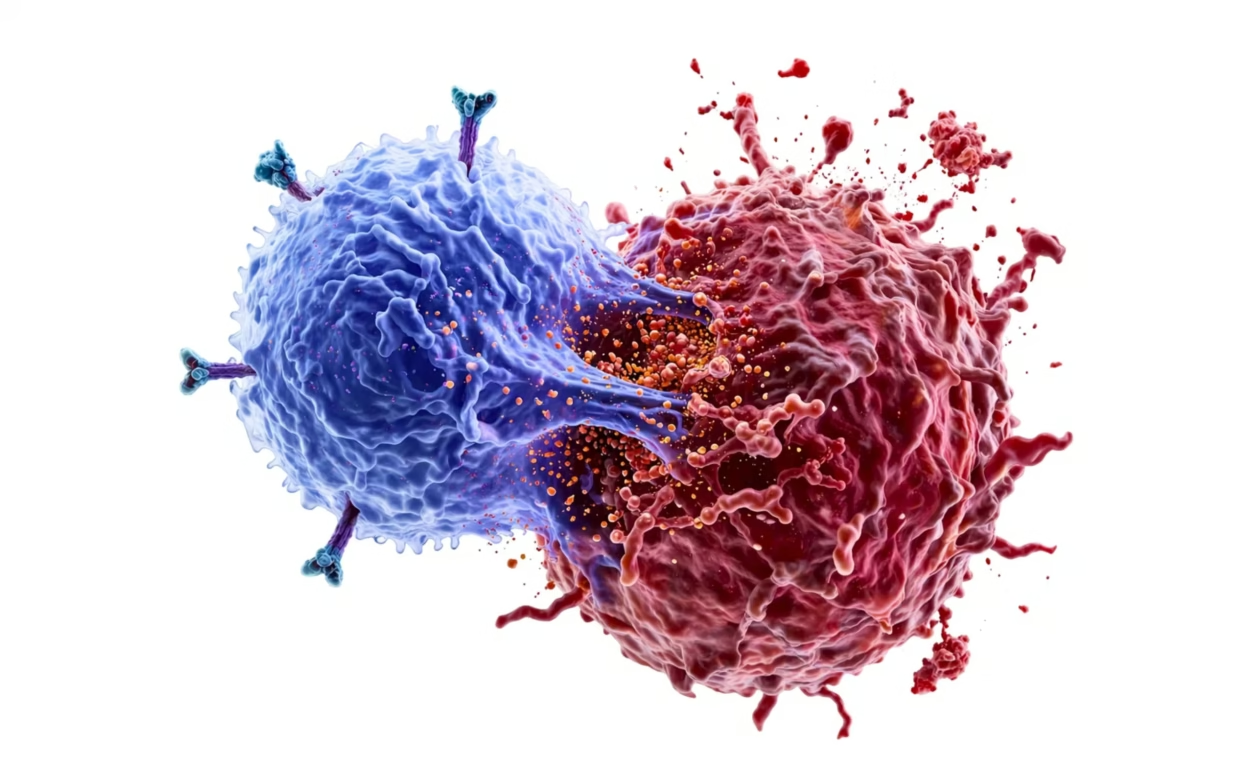
Here’s the simplest way to think about it: your immune system already has cells called T-cells, whose job is to find and destroy threats in your body. The problem with cancer is that it’s very good at hiding from them. CAR-T therapy re-trains those T-cells and gives them a new targeting system, so they can specifically find and attack the leukaemia cells.
“CAR-T” stands for Chimeric Antigen Receptor T-cell therapy. It sounds complex, and the science behind it truly is remarkable. But at its heart, it’s your own immune system being upgraded to fight smarter.
Which Types of Leukaemia Is CAR-T Therapy Used For?
CAR-T cell therapy is most commonly used for B-cell Acute Lymphoblastic Leukaemia (B-ALL), one of the most frequently diagnosed leukaemias in children and also seen in adults. It is particularly considered when leukaemia has relapsed (come back after initial treatment) or when it hasn’t responded adequately to two or more rounds of standard chemotherapy.
Research is also expanding the use of CAR-T for certain other adult blood cancers, including some forms of lymphoma. In the case of Chronic Lymphocytic Leukaemia (CLL), clinical trials are ongoing, but CAR-T therapy remains largely investigational for that condition and is not yet a standard treatment option. Eligibility is always evaluated individually — the oncologist will review the patient’s complete medical history, the biology of their specific cancer, prior treatments, and current health status before recommending whether CAR-T is the right approach.
This is why the first conversation with a specialist is so important: they can assess your particular situation and give you an honest answer about whether this treatment is suitable.
Is CAR-T Therapy for Leukaemia Available in India?
Yes — and this is a question we hear often, because even two or three years ago the answer was less clear. India has made significant progress.
Approved CAR-T therapies are now available in India, including indigenous options that have received regulatory approval, making treatment more accessible and affordable than before.
You don’t need to travel to the US or Europe for this. The right expertise and infrastructure exist right here.
What Does the CAR-T Treatment Journey Look Like?
We want to be honest with you: this is not a one-day procedure. The journey from cell collection to recovery spans several weeks and involves hospital stays. But families who have been through it often say that what helped most was knowing what to expect at each stage.
Before the Infusion
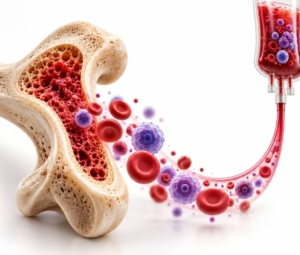
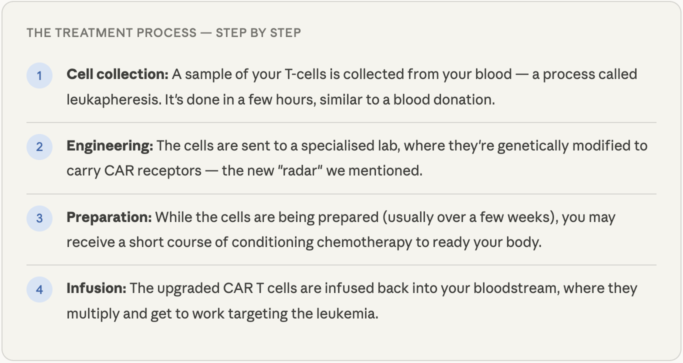
The medical team runs detailed eligibility assessments — blood work, imaging, and heart function tests — to confirm that CAR-T therapy is safe for you. Cell collection, called leukapheresis, is performed at a hospital or specialised centre, takes a few hours, and is typically done on a short-stay or outpatient basis. Most patients go home the same day. During this period, the team will also discuss conditioning chemotherapy and what to expect in the coming weeks.
During Treatment
After the cells are manufactured (a process that usually takes two to four weeks) and conditioning chemotherapy is completed, the CAR-T infusion is administered — usually in a hospital setting. The infusion itself takes just a few hours. Patients are then monitored closely, typically requiring hospital admission for approximately two weeks. The medical team watches for early signs of the immune system’s response and manages any side effects as they arise. This is a critical monitoring period, and having experienced staff around the patient makes all the difference.
After Treatment
Follow-up care continues for months and, in fact, for years. Regular blood tests, bone marrow assessments, and check-ins with the care team are scheduled frequently at first, then gradually spaced out. The team monitors for signs of remission, watches for any complications, and assesses how well the CAR-T cells are functioning. This ongoing connection with your medical team remains important for as long as you’re in remission.
What Are the Side Effects of CAR-T Cell Therapy?
It’s a fair and important question. The two main side effects doctors watch for are Cytokine Release Syndrome (CRS) and Immune Effector Cell-Associated Neurotoxicity Syndrome (ICANS).
Cytokine Release Syndrome (CRS)
CRS happens when the immune system becomes highly active as the CAR-T cells do their job. It can feel like a severe flu response — fever, fatigue, chills, and headache. For some patients it’s mild; for others it’s more pronounced. The important thing is that it is anticipated and well understood. The medical team monitors for it closely, and most patients respond well to supportive care such as fluids, fever management, and — when necessary — specific medications such as tocilizumab, an anti-inflammatory drug commonly used to manage CRS.
ICANS (Immune Effector Cell-Associated Neurotoxicity Syndrome)
This refers to temporary effects on the nervous system. Symptoms can include headaches, confusion, difficulty concentrating, or — in more severe cases — seizures. Most effects are temporary and resolve with appropriate treatment, including corticosteroids. This is managed most effectively at a centre experienced in CAR-T therapy.
These side effects sound concerning, and it’s completely understandable to feel that way. The reassurance is this: when treatment takes place at a centre experienced in CAR-T therapy, these risks are anticipated and actively managed. Most patients recover well with the right supportive care in place.
Why Are Families in India Choosing CAR-T Therapy?
Families across India are increasingly well-informed when it comes to advanced cancer treatments — and more and more, we’re seeing people come in after doing their own research. They’ve read about CAR-T therapy, spoken to other patients, and want to know whether it could be an option for their loved one.
What’s changed significantly in recent years is that you no longer need to fly abroad for this treatment. Specialised cancer centres in India, are now equipped to deliver CAR-T therapy with the full infrastructure and expertise it requires. World-class care is genuinely accessible — closer to home than most families realise.
Frequently Asked Questions
The first step is simpler than most families expect — it's just a conversation. You don't need to arrive with a complete plan or a stack of pre-sorted medical records. Bring what you have, come with your questions, and speak to a specialist who can give you an honest assessment of whether CAR-T is the right path for your loved one.
This is the question every family wants to ask, and we want to give you an honest answer. CAR-T therapy has shown genuinely impressive results for certain types of leukaemia, particularly B-cell ALL. Studies report that many patients achieve early remission, with one-year overall survival rates ranging from 60% to 80% in B-ALL patients treated with CAR-T.
For some patients, remission is durable and lasts for years. For others, the cancer may eventually return, at which point other treatment options can be explored. The reality is that outcomes vary by patient, and no single statistic applies to everyone.
What we can say with confidence is this: CAR-T therapy has given hope and extended life for patients where traditional treatments have failed. Your oncologist can provide more specific guidance about what to expect based on your loved one's individual situation.