14 July 2026
Table of Contents
An advanced ovarian cancer diagnosis Stage III or IV is frightening and we won’t pretend otherwise. But we also want to share something equally true, that the treatment landscape for advanced ovarian cancer has changed substantially over the past decade. Targeted therapies, particularly PARP inhibitors, have transformed outcomes for many patients. Surgical techniques have advanced and a much deeper understanding of the disease’s biology now shapes treatment in ways that simply weren’t possible even ten years ago. This guide is here to walk you through what that means for you or your loved one.
Ovarian cancer is often called a “silent” disease because it frequently isn’t caught until it has spread beyond the ovaries. This guide focuses specifically on advanced-stage disease where we will look at what treatment looks like today in India, what’s genuinely new and effective, and how to find the right specialist team to guide you through it.
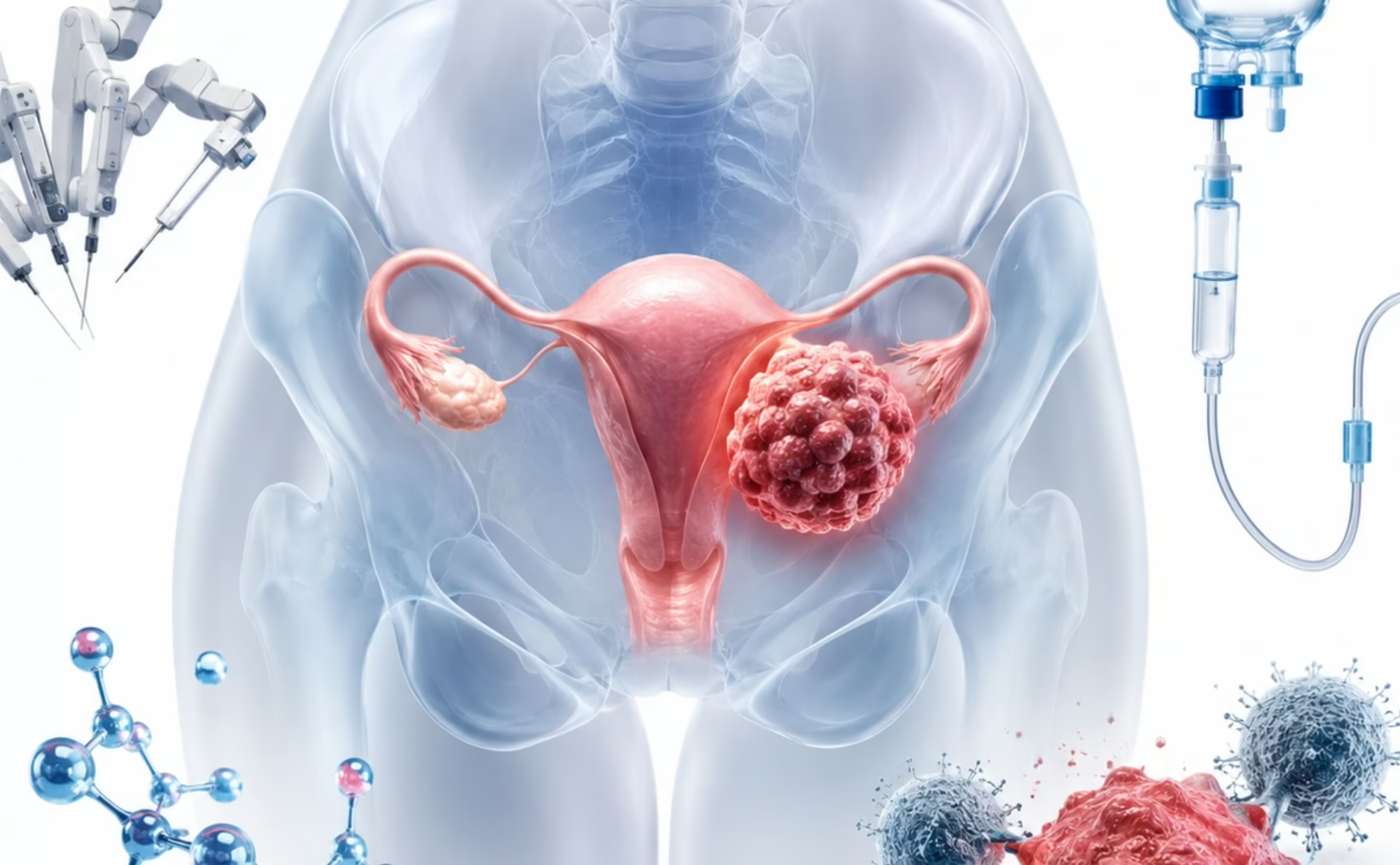
Why Ovarian Cancer Is Often Diagnosed at an Advanced Stage
Ovarian cancer doesn’t have a reliable screening test, unlike cervical cancer with its Pap smear, or breast cancer with mammography. The ovaries sit deep within the pelvis and early symptoms like bloating, pelvic discomfort, changes in appetite, feeling full quickly, or urinary changes are often vague and easily mistaken for digestive issues or normal hormonal fluctuations. By the time more obvious symptoms appear, the cancer has frequently already spread beyond the ovaries to the pelvis or abdomen.
This is the reason roughly 70% of ovarian cancer cases are diagnosed at Stage III or IV. It is not a reflection of anything done wrong by the patient or their doctor, it is a reflection of how this particular cancer behaves and how difficult it is to detect early with current technology. Understanding this helps reframe the diagnosis: being at an advanced stage doesn’t mean something was missed. It means you’re now part of a very large, well-studied group of patients for whom modern treatment has made real, measurable progress.
Understanding Advanced Ovarian Cancer (Stages III and IV)
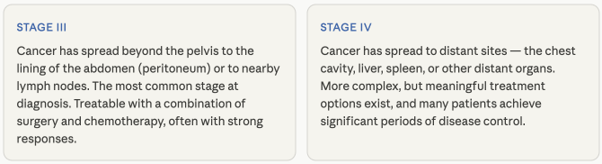
Within these stages, there’s considerable variation in outlook depending on the specific subtype of ovarian cancer, how much disease can be surgically removed, and increasingly important, the molecular and genetic characteristics of the tumour. This last point is one of the most significant developments in ovarian cancer care over the past decade and it’s worth its own dedicated explanation.
Why Biomarker Testing Changes Everything
If there’s one thing every patient with advanced ovarian cancer should know, it’s this: genetic and molecular testing of the tumour and often of the patient’s own genetics has become absolutely central to modern treatment decisions. This isn’t an optional extra. It directly determines which treatments are likely to work best.
The single most important test is for BRCA1 and BRCA2 mutations, the same genes associated with hereditary breast cancer. Around 15-20% of ovarian cancer patients carry a BRCA mutation, either inherited or acquired specifically in the tumour. This matters enormously because BRCA-mutated ovarian cancers respond particularly well to a class of drugs called PARP inhibitors which is one of the most important advances in ovarian cancer treatment in the last ten years.
Beyond BRCA, broader testing for homologous recombination deficiency (HRD) which is a feature found in a larger group of ovarian cancers beyond just BRCA-mutated ones and has further expanded who can benefit from PARP inhibitor therapy. Comprehensive genomic testing at diagnosis, ideally including both germline (inherited) and tumour-specific testing, should be standard practice for every patient with advanced ovarian cancer.
Modern Treatment Options for Advanced Ovarian Cancer in India
Treatment for advanced ovarian cancer in India typically combines surgery and chemotherapy, with targeted therapy now playing a major role in extending remission. Here’s what each part involves:
Surgery - debulking and cytoreduction
Surgery is a cornerstone of advanced ovarian cancer treatment, and the goal is what’s called “optimal cytoreduction” which is removing as much visible tumour as possible, ideally leaving no residual disease behind. This is technically demanding surgery, often involving not just the ovaries and uterus but sometimes parts of the bowel, peritoneum, spleen, or diaphragm, depending on where the cancer has spread. The amount of tumour successfully removed at surgery is one of the strongest predictors of how well a patient will do, which makes the surgeon’s experience and skill genuinely critical.
Depending on the extent of disease at diagnosis, surgery may happen first (primary debulking) followed by chemotherapy, or chemotherapy may be given first to shrink the tumour before surgery (neoadjuvant chemotherapy followed by interval debulking). The right sequencing depends on how extensive the disease is and the patient’s overall fitness.
Chemotherapy
Standard chemotherapy for advanced ovarian cancer combines a platinum agent (carboplatin) with a taxane (paclitaxel), given in cycles either before or after surgery. This combination remains highly effective and is the backbone of treatment for the vast majority of patients. Many patients achieve a strong response, with disease becoming undetectable or significantly reduced.
PARP inhibitors - maintenance therapy that has changed outcomes
This is one of the most important advances in ovarian cancer treatment of the last decade. PARP inhibitors are drugs like olaparib, niraparib, and rucaparib which work by blocking a DNA repair pathway that cancer cells (particularly those with BRCA mutations or HRD) rely on to survive. Given as maintenance therapy after chemotherapy, PARP inhibitors have significantly extended the time patients stay in remission in some BRCA-mutated patients, by years rather than months.
These drugs are available in India and have become a standard part of treatment planning for advanced ovarian cancer, particularly for patients with BRCA mutations or HRD-positive tumours. This is precisely why biomarker testing at diagnosis matters so much as it determines whether and how PARP inhibitor maintenance therapy should be used.
Targeted therapy - bevacizumab
Bevacizumab, an anti-angiogenic drug that blocks the tumour’s ability to form new blood vessels, is used in combination with chemotherapy and/or as maintenance therapy for some patients with advanced ovarian cancer, particularly those with higher-risk features. It is available in India and is another tool that can be combined with or used as an alternative to PARP inhibitors depending on the patient’s specific tumour characteristics.
Immunotherapy - an emerging option for selected patients
While immunotherapy has transformed the treatment of several cancers, its role in ovarian cancer is more selective. Immune checkpoint inhibitors such as pembrolizumab may be recommended for a small group of patients whose tumours have specific biomarkers. These drugs work by helping the immune system recognise and attack cancer cells.
Researchers are also studying immunotherapy in combination with chemotherapy, targeted therapies and other novel agents to improve outcomes for advanced ovarian cancer. Immunotherapy may be considered in carefully selected cases, particularly in recurrent disease or through participation in clinical trials. Discussing biomarker testing with your oncologist can help determine whether immunotherapy is a suitable option.
HIPEC - heated chemotherapy delivered directly to the abdomen
For selected patients, particularly those undergoing surgery for ovarian cancer that has spread within the abdominal cavity, HIPEC (Hyperthermic Intraperitoneal Chemotherapy) may be considered. This involves delivering heated chemotherapy directly into the abdominal cavity at the time of surgery, targeting microscopic disease that surgery alone might miss.
When Ovarian Cancer Returns: Treating Recurrent Disease
Unfortunately, advanced ovarian cancer has a meaningful chance of recurrence even after a strong initial response to treatment. This is a difficult reality, but it’s important to know that recurrent ovarian cancer remains genuinely treatable and for many patients, multiple further lines of effective treatment exist.
How recurrence is treated depends significantly on one key factor: how long ago the initial treatment ended. Cancer that recurs more than six months after completing platinum-based chemotherapy (“platinum-sensitive” recurrence) generally responds well to further platinum-based chemotherapy, often combined with a PARP inhibitor or bevacizumab. Cancer that recurs sooner (“platinum-resistant” recurrence) is more challenging but still treatable, typically with non-platinum chemotherapy options, sometimes combined with bevacizumab, or through clinical trials of newer agents.
For patients who didn’t receive a PARP inhibitor as maintenance after their first treatment, this becomes an important option to revisit at recurrence, particularly for those with BRCA mutations or HRD-positive disease. Clinical trials are also especially valuable to explore at the point of recurrence, as newer combinations and novel agents are continually being studied for ovarian cancer.
Finding the Right Specialist for Advanced Ovarian Cancer in India
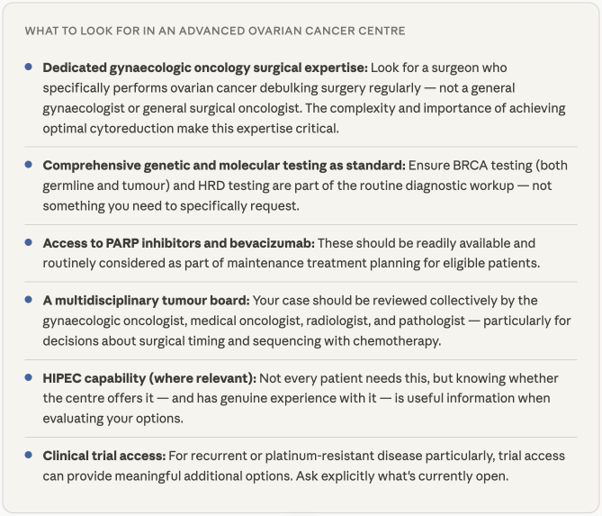
Advanced ovarian cancer is best managed by a gynaecologic oncologist, a specialist trained specifically in surgery and treatment for cancers of the female reproductive organs ideally within a multidisciplinary team. Here’s what to look for:
Frequently Asked Questions
For Stage III ovarian cancer, a meaningful proportion of patients achieve long-term remission, particularly with optimal surgery, effective chemotherapy, and appropriate maintenance therapy like PARP inhibitors. Stage IV is more challenging and cure is less common, but long-term disease control sometimes for many years is achievable for many patients. Outcomes vary considerably based on the specific tumour biology, BRCA/HRD status, and how the disease responds to initial treatment. Your oncologist can give you more specific information based on your individual case.
A PARP inhibitor is a targeted drug that's particularly effective in ovarian cancers with BRCA mutations or HRD (homologous recombination deficiency) both of which affect how cancer cells repair their DNA. Yes, genetic testing of both of your own genes (germline BRCA testing) and the tumour itself is essential to determine whether and how PARP inhibitors should be used in your treatment plan. This testing should be done at diagnosis if it hasn't been already.
Not always. For some patients, surgery is performed first, followed by chemotherapy. For others, particularly those with very extensive disease chemotherapy is given first to shrink the tumour, followed by surgery (called interval debulking), and then further chemotherapy. The right approach depends on how extensive the disease is at diagnosis and the patient's overall fitness for surgery. This decision should be made by an experienced gynaecologic oncology team after a thorough evaluation.
Yes. While BRCA-mutated and HRD-positive ovarian cancers respond particularly well to PARP inhibitors, patients without these features still benefit significantly from standard chemotherapy, surgery, and bevacizumab-based maintenance therapy. Some HRD testing also identifies a broader group of patients (beyond just BRCA-mutated) who may still benefit from PARP inhibitors. Your oncologist will explain what your specific test results mean for your treatment options.
Advanced ovarian cancer treatment has changed substantially in the last decade. Better surgical outcomes, the rise of PARP inhibitors, and a much deeper understanding of tumour biology mean that many patients today achieve longer, better-controlled remissions than would have been possible even ten years ago. The right specialist team — and the right testing done at the right time — make a genuine difference.