09 September 2026
Table of Contents
If you’ve been told your treatment plan may involve a bone marrow transplant, you’ve likely heard the term “HLA matching” come up — often without much explanation of what it actually means. Here’s the honest answer: HLA matching is simply the process of finding a donor whose immune markers are close enough to yours that your body is unlikely to reject the new stem cells, or the new cells attack your body.
Let’s walk through this together. This guide explains what HLA is, how testing works, what the different degrees of match mean, and where a suitable donor is typically found.

What Is HLA, and Why Does It Matter?
HLA stands for human leukocyte antigen — a set of proteins found on the surface of most cells in your body. Think of HLA markers as an identification system your immune system uses to distinguish “self” from “foreign.” Every person’s combination of HLA markers is inherited from their parents, which is why close relatives are more likely to share a similar HLA profile than unrelated people.
In a bone marrow transplant, this matters enormously. If a donor’s HLA markers are too different from the recipient’s, the transplanted immune cells may recognise the recipient’s body as foreign and attack it — a serious complication called graft-versus-host disease. The recipient’s remaining immune system could also reject the donor cells if the mismatch is severe. Close HLA matching reduces both of these risks.
How HLA Testing Actually Works
HLA testing involves a blood or cheek swab sample, analysed in a laboratory to identify specific markers — typically at least ten key points across several HLA genes. Both the patient and any potential donors undergo this testing, and the results are then compared.
KEY FACT
A “10/10 match” refers to matching at ten key HLA points between donor and recipient. This is generally considered the gold standard, though transplants can still succeed with fewer matching points depending on the situation.
This testing typically takes a few weeks to complete for each potential donor, which is part of why the donor search process is often started as early as possible once a transplant is being considered.
Degrees of Match: From Full Match to Half-Match
Not every transplant requires a perfect match, and understanding the range of possibilities can ease some of the anxiety around the search.
- Full match (matched sibling or unrelated donor). All or nearly all key HLA points match. A full sibling has roughly a 1 in 4 chance of being a full match, since HLA type is inherited.
- Mismatched unrelated donor. A donor found through a registry who matches at most, but not all, key points. Outcomes can still be very good depending on which points differ.
- Haploidentical (half-match) donor. A donor, often a parent or child, who matches at roughly half of the key points. Advances in transplant technique have made half-matched transplants increasingly successful and accessible.
- Umbilical cord blood. Cord blood units require less strict matching than adult donor cells, making them a useful option when a closer match isn’t available.
Where Doctors Look for a Matching Donor
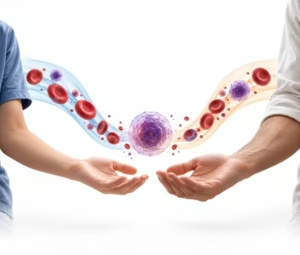
The search for a donor typically starts close to home and widens outward. Full siblings are tested first, given the relatively high likelihood of a match. If no sibling match is available, the search extends to international donor registries, which list millions of potential volunteer donors worldwide.
If a suitable unrelated donor isn’t identified, or time doesn’t allow for a lengthy search, the care team may consider a half-matched family member or a cord blood unit instead, both of which are typically available more quickly.
What Happens If No Perfect Match Is Found
CAR-T therapy is generally considered for patients with B-cell NHL or ALL whose cancer has relapsed after treatment or hasn’t responded adequately to standard chemotherapy. It’s a decision made carefully, in consultation with a hemato-oncology team, taking into account the specific subtype of cancer, prior treatments received, overall health, and organ function.
Not every patient is automatically eligible — the treatment does place demands on the body, particularly during the monitoring period, so your care team will assess whether you’re likely to tolerate the process safely. This is a conversation worth having directly with a specialist who knows your full medical history.
What Happens If No Perfect Match Is Found
IMPORTANT
A perfect match is ideal but not always essential. Advances in transplant medicine mean that half-matched and mismatched transplants are performed successfully every day, with careful management of the additional risks involved.
Your transplant team will weigh the closeness of available matches against the urgency of your situation, recommending the option most likely to give you a good outcome given everything available at the time.
Types of Donor Matches Compared
Broad categories of donor match, from closest to more distant.
Match Type | Typical Source | Key Consideration |
Full match | Sibling or unrelated registry donor | Lowest risk of rejection or GVHD |
Half-match (haplo) | Parent, child, or half-matched relative | Widely available, increasingly successful |
Cord blood | Public or private cord blood bank | Less strict matching required |
Frequently Asked Questions
Parents are typically a half-match (haploidentical) to their children, since each parent contributes half of a child's HLA markers. Full matches between parent and child are uncommon.
This varies considerably. A sibling match can be confirmed within weeks; an unrelated registry search can take anywhere from a few weeks to several months, depending on how common or rare your specific HLA type is.
Not necessarily. Blood type (ABO) is a separate system from HLA type, and transplants across different blood types are routinely performed successfully.
Yes, identical twins share essentially identical HLA markers, making them ideal matches when available, though this is a rare situation in practice.
Half-match transplants carry a somewhat higher risk profile than full matches, but modern techniques have significantly improved their safety and success rates, making them a reliable option when a full match isn't available.
Your care team will search unrelated donor registries and consider cord blood options. Most patients do find a workable option through one of these routes.
A Final Word
Waiting on donor matching results can be one of the more uncertain parts of the transplant journey. What this means for you is that the search process is thorough and multi-layered by design — moving from sibling, to registry, to alternative sources like half-matched donors or cord blood — precisely so that a workable path forward can usually be found.
If you have questions about where you or your family member currently stands in the donor search process, your bone marrow transplant team can walk you through the specifics and what to expect next.